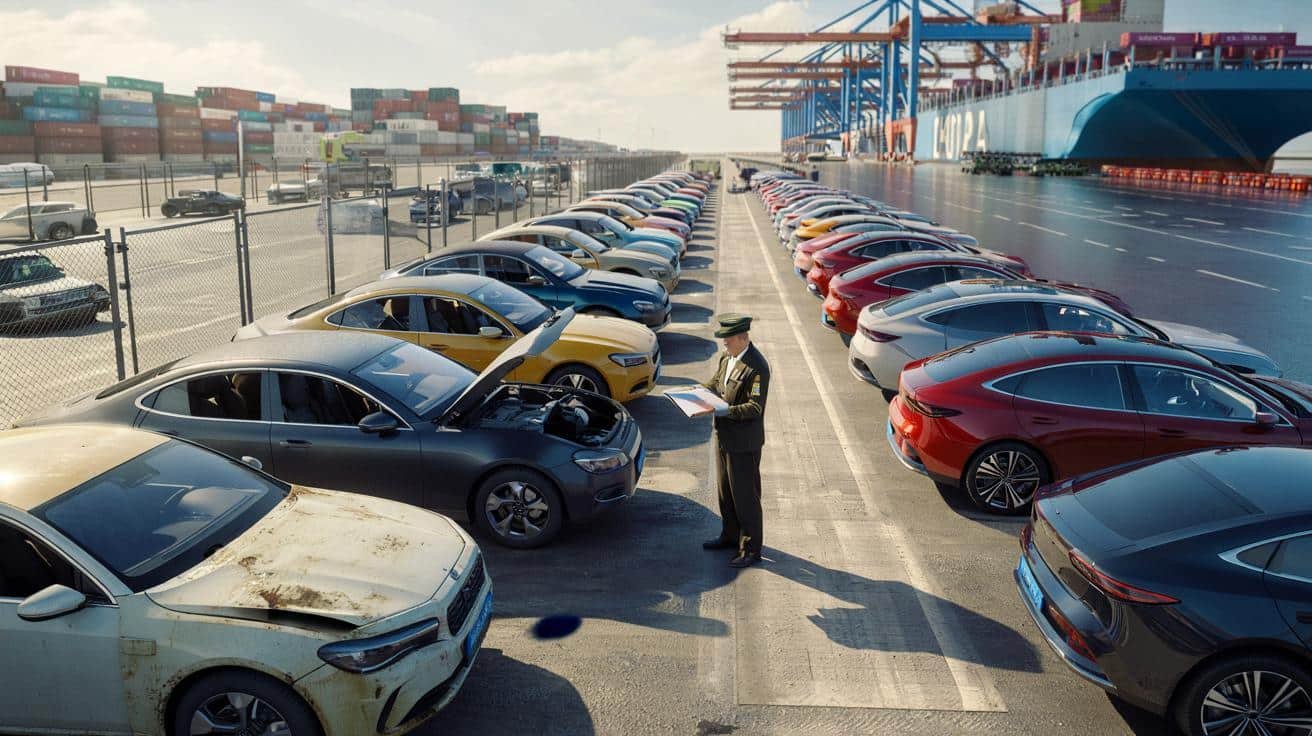
French drivers have grown used to cheap Chinese cars with tempting price tags and worrying question marks.
That era may be ending.
Beijing is quietly rewriting the rulebook for the vehicles that leave its ports, signalling that the age of “good enough for export” could be over. For France and the rest of Europe, this shift may reshape the bargain end of the car market far faster than many expected.
China’s new line: no more “throwaway” export cars
According to Chinese industry officials and early regulatory drafts, authorities plan to block exports of vehicles judged low quality or unsupported by a reliable spare‑parts network. The move directly targets cars that often land in Europe with attractive prices but unclear long‑term backing.
China wants exported cars to match the quality, safety and after‑sales standards it showcases at home, not a cheaper second tier for foreign buyers.
Until now, Chinese manufacturers could offload end‑of‑line or bare‑bones models into price‑sensitive markets with limited oversight. These vehicles were not always unsafe, but they often lacked:
- robust corrosion protection for harsh climates
- modern driver‑assistance systems expected in Europe
- clear guarantees on spare parts availability
- solid dealer or repair networks abroad
The planned export filter would push brands to maintain a minimum bar for durability, safety, and after‑sales commitments. Cars without assured parts pipelines or serviceability could stay inside China or be dropped from production altogether.
Why France became a symbol of the problem
France illustrates both the attraction and the frustration triggered by some Chinese imports. Budget‑conscious buyers facing high fuel prices, low purchasing power and long waiting lists for European EVs turned to unknown badges from Shenzhen or Wuhan.
In provincial dealerships and online platforms, these models promised modern styling, big screens and low monthly payments. The catch often came later.
When cheap becomes costly
Owners and independent garages in France have reported recurring issues with certain low‑cost Chinese cars:
- delays of several months for basic body parts or electronic modules
- software bugs with no clear update path
- warranty conditions difficult to enforce with distant importers
- resale values collapsing after just a few years
In some cases, vehicles became almost impossible to repair economically after a medium crash or a battery defect, effectively turning them into expensive waste.
For a car that cost less than a mainstream European rival, a single unavailable part could wipe out any savings and strand the vehicle in a yard.
This pattern fed the perception that part of the Chinese offer rested on disposability rather than longevity. Beijing now seems worried that such stories damage its broader auto ambitions, especially as Chinese brands push into the higher end of the market with EVs and plug‑in hybrids.
Beijing’s strategic pivot: from volume to reputation
China has grown into the world’s largest car exporter, outpacing Japan and Germany in recent years. The first phase focused on volume: send as many units as possible to any market willing to take them. The new approach signals a second phase focused on reputation and brand value.
Officials in Beijing see the car industry as a key showcase for Chinese technology, especially in batteries, software and electric powertrains. Stories about unsafe or unrepairable models clash with that narrative.
By installing an export filter, the government aims to:
- protect Chinese brands that invest heavily in quality and innovation
- prevent a “race to the bottom” in overseas markets
- calm trade tensions by aligning more closely with foreign safety expectations
- prepare the ground for higher‑margin models in Europe and North America
The message to manufacturers is blunt: if your car cannot be maintained properly abroad, it has no place on an export ship.
What this means for French and European drivers
For motorists in France, the shift could play out in several ways. Some ultra‑cheap offers may simply vanish. Importers that relied on obscure Chinese factories might lose access to stock, or find that their former suppliers need major upgrades to pass the new export rules.
At the same time, better‑known Chinese brands already established in Europe may welcome the change. They can argue that their vehicles meet higher standards, and distance themselves from stories of orphaned cars without parts.
Fewer unknown brands, stronger after‑sales promises
The French market may gradually move from a wild west of small badges to a more structured landscape with a limited number of serious players. That usually brings clearer warranties and more predictable maintenance paths.
Drivers tempted by Chinese models in a few years’ time might see:
- longer, more detailed warranties tied to parts availability
- local partnerships with large dealer networks
- transparent battery guarantees and recycling channels for EVs
- better compatibility with European diagnostic tools
Prices could rise slightly at the very low end, since manufacturers will need to spend more on rust protection, crash structures, software support and logistics. Yet many households may accept a modest increase if it comes with fewer nasty surprises after three or four years.
Quality, safety and the EV transition
The export crackdown also intersects with Europe’s rapid shift towards electric cars. A significant share of Chinese exports now consist of EVs and plug‑in hybrids, sometimes sold under European brands that assemble or source in China.
Ensuring a steady supply of high‑voltage components and battery modules matters far more for an electric vehicle than for a simple petrol runabout. A missing coolant valve or control module can disable the entire car.
| Aspect | Low‑quality export risk | Impact on EV owners |
|---|---|---|
| Battery modules | Discontinued models, no compatible replacements | Vehicle immobilised, high replacement cost |
| Power electronics | No stock outside China, long shipping delays | Weeks without a car, pressure to scrap early |
| Software updates | No over‑the‑air or dealer update capability | Range issues, charger incompatibility, safety recalls hard to manage |
By forcing exporters to show credible spare‑parts and software plans, Beijing indirectly supports the environmental case for EVs. An electric car that becomes unusable after six years due to missing parts does little for climate goals or resource efficiency.
Pressure on European manufacturers
There is a twist for French and European carmakers. For years, they warned that cheap Chinese imports threatened local jobs and standards. Now, China is voluntarily tightening the screws on the least reliable part of its offer.
This could make the competitive picture more complex. European brands will no longer face only a flood of rock‑bottom budget models. They will increasingly compete against better engineered Chinese cars, often with cutting‑edge battery tech and aggressive pricing.
To stay attractive, French manufacturers may need to step up in areas where they currently lag some Chinese rivals:
- charging speed and real‑world range for mid‑price EVs
- intuitive infotainment and over‑the‑air updates
- transparent and simple pricing models for batteries and software options
- guaranteed parts availability for a decade or more
China does not want to be seen as the home of cheap, disposable cars anymore. It wants to be treated like a top‑tier automotive power.
How drivers can protect themselves right now
While Chinese regulators prepare their new framework, French consumers still need to navigate today’s market. A low upfront price should never be the only criterion. Before signing a contract, a buyer can check several practical points.
- Ask which official importer stands behind the brand and how long it has operated in France.
- Request written guarantees on parts availability for at least eight to ten years.
- Check whether independent garages can access diagnostic tools and technical data.
- Look at insurance conditions, especially for EV batteries and electronics.
- Search for real‑world owner feedback in France, not just glossy reviews or sponsored videos.
These steps apply to Chinese cars, but also to lesser‑known European or start‑up brands. A vehicle that cannot be repaired economically after a minor collision harms both the household budget and the environment.
Beyond China: a broader shift in how we think about cars
China’s move speaks to a deeper question: how long should a modern car remain truly usable? In theory, EVs and hybrids can last for many years if crucial parts stay available and software keeps pace with charger standards. In practice, supply chains and corporate decisions often decide their fate.
Some European regulators already discuss minimum support periods for batteries and critical electronics. Insurance companies, faced with high write‑off rates for recent EVs, quietly lobby for better parts planning and repairability rules. China’s export filter could accelerate these debates in Brussels and national capitals.
For drivers, this new landscape rewards those who look past the sticker price. A car is turning into a long‑term digital device with wheels, connected to servers, apps and specialised workshops. Stability, update policies and spare‑parts pipelines now matter as much as horsepower or alloy wheels.